


Kevin Rudd faces a diplomatic storm as past criticisms of Donald Trump resurface just as he pledges readiness to work with the new administration. With his ambassadorial future in doubt, Rudd must balance professionalism, political pressure, and the shadow of old tweets. Will his efforts at reconciliation secure his post or hasten his downfall?
Written by Ms. Sao Sodanin (SODA)
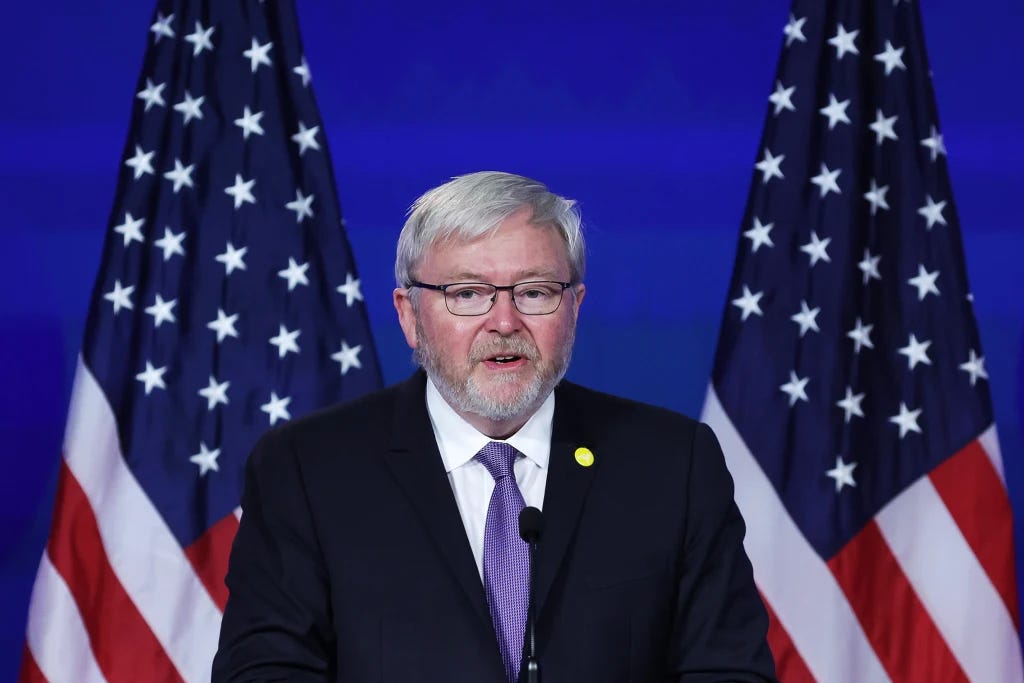
Reading the recent report on Kevin Rudd’s position as Australia’s Ambassador to the United States gave me a lot to think about. It reminded me of how fragile diplomacy can be when personal history and politics collide. Rudd, once a two-time prime minister, is now trying to present himself as fully ready to work with Donald Trump, who has just been re-elected. Yet, despite his confidence, I couldn’t help but notice the tension between his professional role and the weight of his past words.
What stood out most to me was Rudd’s repeated insistence that he and his team are “ready” to work with Trump’s incoming administration. It felt like he was not only speaking to the public but also sending a subtle message to Trump himself: “I’m committed, please give me a chance.” On one hand, I admire Rudd’s determination to put forward a professional face despite the criticism. On the other hand, it is a stark reminder of how a few words on social media calling Trump a “traitor to the West” and “the most destructive president in history” can come back years later to haunt someone at the highest levels of diplomacy.
This made me reflect on how cautious we all need to be with what we say online. Rudd’s case proves that even experienced politicians can underestimate the long-term consequences of their words. In my own life, this makes me think twice about how I communicate on platforms like Facebook or X. Once something is said, it can resurface at the worst possible time.
The article also made me think about power dynamics. Trump’s response to Rudd during the campaign was dismissive, calling him “a little bit nasty” and “not the brightest bulb.” Even more striking was Daniel Scavino Jr.’s repost of Rudd’s apology statement with an hourglass gif, symbolizing that time was running out for him. That kind of gesture felt less like diplomacy and more like a warning shot. It showed me that politics can sometimes be more about symbolism and ego than about quiet negotiations.
Still, I found it interesting that many Australian political figures rallied behind Rudd. Simon Birmingham, Tony Abbott, and Malcolm Turnbull all expressed that he should be allowed to stay on as ambassador. I was surprised by the cross-party support. Abbott’s point that the U.S. shouldn’t decide who Australia sends as ambassador seemed particularly important it was about protecting national sovereignty. Turnbull’s blunt remark that “you don’t succeed with Trump by kissing his ass” also stood out because it revealed how different leaders approach Trump’s personality. These reactions reminded me that diplomacy isn’t just about one individual; it’s also about how a country projects its independence.
Caroline Kennedy’s comments gave me another perspective. As the outgoing U.S. Ambassador to Canberra, she praised Rudd as energetic, effective, and well-connected. Her endorsement made me think that sometimes the work a diplomat does behind the scenes can matter more than their public image. Even if Trump holds grudges, the relationships Rudd has built in Congress could help keep him in his position.
In reflecting on all of this, I realized that being a diplomat is not just about representing your country it’s also about personal resilience. Rudd has to prove that he can move past his old criticisms and work pragmatically with a leader he once strongly opposed. I think this takes humility, but it also shows how quickly political roles can change. One day you’re free to criticize, and the next day you’re expected to build bridges with the very person you criticized.
For me, the key lesson from this story is that words matter, especially in public life. But I also see a hopeful side: diplomacy can survive even when personalities clash, as long as both sides value the relationship. Australia and the U.S. share deep strategic ties, and I believe those ties will ultimately matter more than old tweets.