


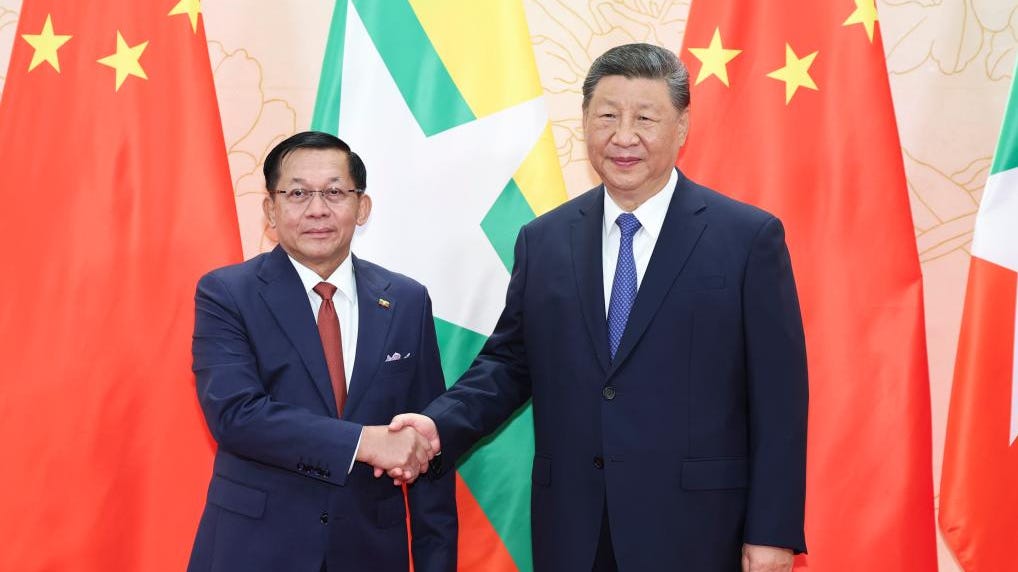
China and Myanmar are strengthening their ties as Xi Jinping meets acting President Min Aung Hlaing in Tianjin. With discussions ranging from economic corridors to cross-border security, the partnership aims to bring stability and development to both nations. The meeting highlights China’s strategic influence in Southeast Asia and Myanmar’s willingness to align on key regional and political initiatives.
Written by: Ms. Sao Sodanin (SODA)
Today I read about the meeting between Chinese President Xi Jinping and Myanmar’s acting president, Min Aung Hlaing, in Tianjin during the Shanghai Cooperation Organization (SCO) Summit 2025. The meeting caught my attention because it highlighted China’s ongoing strategic engagement with its neighboring countries, not just Cambodia but also Myanmar, which is often considered more politically sensitive due to its internal instability.
President Xi emphasized that Myanmar is an important dialogue partner of the SCO and that the two countries should deepen strategic cooperation. I find this interesting because it shows China’s long-term approach to building regional influence. Xi also stressed accelerating the construction of a “community with a shared future,” which seems to be both a diplomatic phrase and a real policy goal, aimed at bringing tangible benefits to the peoples of both nations. It made me reflect on how China positions itself as a stabilizing force, promising both economic and political support to countries that face internal challenges.
One thing that struck me is Xi’s focus on domestic political unity in Myanmar. He mentioned that China supports Myanmar in restoring stability and boosting development. Reading this, I feel a mix of hope and caution. On one hand, stability and development are essential for Myanmar’s people, who have endured years of political unrest and economic challenges. On the other hand, I wonder about the balance between foreign support and internal sovereignty—how much influence should an external power like China have over Myanmar’s political choices?
The meeting also highlighted concrete economic initiatives, such as the China-Myanmar Economic Corridor. From my perspective, this is a key part of China’s approach: combining diplomacy with economic development. Projects like this can provide jobs, improve infrastructure, and strengthen trade. However, it also made me think about the risk of dependency. Myanmar’s economy could benefit greatly in the short term, but relying heavily on a single partner may limit its long-term autonomy.
Security cooperation was another major theme. Xi mentioned collaboration to combat cross-border crimes and ensuring the safety of Chinese personnel, institutions, and projects in Myanmar. This struck me as very practical: diplomacy is not only about agreements and summits but also about protecting investments and people. It reminds me that international relations are as much about security and stability as they are about trade and development.
Min Aung Hlaing expressed Myanmar’s gratitude for China’s long-term support in economic and social development, post-disaster reconstruction, and maintaining peace in northern Myanmar. He also pledged Myanmar’s adherence to the one-China principle, which signals alignment on sensitive geopolitical matters. I found this noteworthy because it shows that strategic cooperation often comes with shared political commitments, not just economic or social benefits.
During the meeting, both sides signed bilateral cooperation documents covering areas such as customs and media. While this may seem like routine diplomacy, I feel it is part of a larger plan to strengthen institutional ties, creating a foundation for deeper collaboration in the future. The presence of senior Chinese officials like Cai Qi, Wang Yi, and Chen Min’er underlines the significance China places on this relationship.
Reflecting on the meeting, I feel that China’s engagement with Myanmar is a combination of diplomacy, economics, and strategic influence. For Myanmar, the partnership promises support and stability, which is very appealing given its current challenges. At the same time, it raises questions about sovereignty and long-term independence, as reliance on a powerful neighbor can be double-edged.
Personally, I see this as an example of how international relations operate at multiple levels: historical context, economic development, political alignment, and security. China’s approach seems comprehensive, aiming to build trust and shared benefits, but it also highlights the delicate balance smaller nations must navigate in their relationships with major powers.
Overall, this meeting made me reflect on the interconnectedness of Southeast Asia and the importance of regional cooperation. If managed wisely, partnerships like these can bring real improvements to citizens’ lives, yet they also require careful consideration to avoid over-dependence and preserve national autonomy. For me, it reinforces that diplomacy is not just about agreements between leaders it is ultimately about shaping the future of people and nations.
